
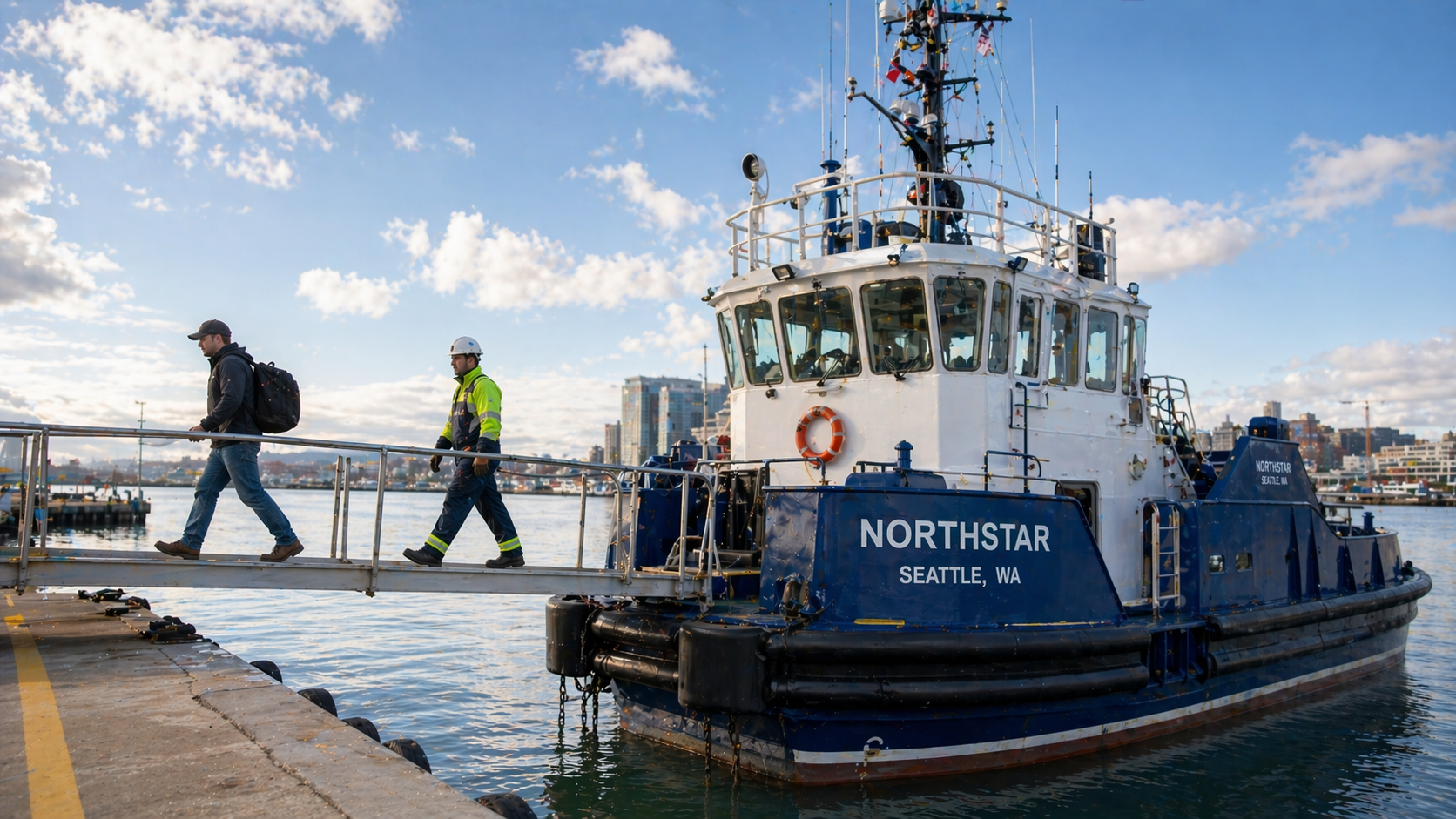
Crew Rotation, Handover, and the Hidden Knowledge Loss on Commercial Vessels
On the day a senior engineer rotates off a workboat, a tremendous amount of institutional knowledge leaves with them. Which pump has been slowly getting noisier for a month. Which valve on the number two generator takes an extra quarter-turn to fully close. The deferred defect the engineer was planning to address at the next alongside period but hadn't yet written up.
That knowledge rarely makes it into the formal handover. It lives in someone's head, makes it to the oncoming engineer over a cigarette on the dock if you're lucky, and disappears entirely if the rotation involves a cross-rotation or a crewing agency swap.
For most commercial operators, this slow, invisible leak of operational knowledge is one of the largest and most under-examined drivers of unplanned downtime, crew frustration, and avoidable maintenance cost. And it's almost entirely fixable.
Why Handover Fails on Most Vessels
Handover is a cultural practice before it's a document. On vessels where the culture treats handover as a box-check between outgoing and incoming crew, the document usually reflects that - a thin status summary that captures what was working that week, but not what was trending, what was deferred, or what was being quietly watched.
Time pressure. Handover typically happens in the last hour of a shift, when the outgoing crew is eager to leave and the incoming crew is still finding their bunks. The most important conversation of the rotation happens under the worst possible conditions.
The medium. Handover notes are often handwritten on a clipboard, saved in a Word document on a shared laptop, or emailed between personal accounts. They're not indexed, not searchable, and not accessible to anyone ashore. Three rotations later, the note that would have explained a recurring fault is lost in a folder no one opens.
Scope. Formal handover typically covers "what happened this rotation." It rarely covers "what I noticed but didn't report" - which is exactly the category of information that turns into a casualty two rotations later.
How Knowledge Loss Compounds Across Rotations
Over a twelve-month period on a typical commercial vessel with a two-week rotation, there are twenty-six handover events. If each one loses even five percent of relevant operational detail - a conservative estimate - the cumulative loss over a year is substantial.
The most expensive consequence of this compounding loss is the repeat fault. A crew member who fixed the same component six months ago is almost never the crew member troubleshooting the same fault today. The fix happens again, often with the same time investment, sometimes with the same mistakes. And nobody realizes it's a pattern because nobody has a view across the full rotation history.
What Structured Digital Handover Actually Changes
Digital handover done well is not a fancier version of the clipboard. It changes the structure, the history, and the visibility.
It enforces structure. Every handover captures the same categories - open defects, deferred maintenance, items under observation, pending parts, crew training updates, operational notes - so the incoming crew knows exactly where to look for each type of information.
It builds a searchable history. Six months later, when a component starts behaving oddly, the incoming engineer can pull every prior handover note referencing that component in seconds. Patterns that were invisible become obvious.
It brings shore into the loop. Port captains, port engineers, and operations managers see handover content in real time rather than a weekly summary. A pump model failing more often across three vessels becomes a conversation with the OEM, rather than a coincidence noticed by three engineers who never compared notes.
The Crew Adoption Objection (and Why It Doesn't Hold Up)
The most common pushback on structured digital handover is that crews won't use it. A well-designed handover interface takes less time to complete than a handwritten clipboard note, because it uses pre-populated fields, photo capture, and voice input to reduce typing to the minimum. The friction argument made more sense in 2015. It doesn't hold up in 2026.
Operators who succeed at crew adoption roll out the handover workflow alongside a tool the crew already finds useful - usually maintenance scheduling or defect reporting - so handover feels like a natural extension of something helpful, not an extra task handed down from the office.
A Simple Test for Your Own Operation
Step 1 - Pull the last ten handover documents from any one vessel. Use whatever format those handovers are currently in: paper, email, shared document, doesn't matter.
Step 2 - Read them in sequence. Not individually - in sequence, the way a new crew member would experience the vessel's recent history if they had access to all of them.
Step 3 - Count how many times a component, fault, or operational concern appears across multiple handovers without being resolved. Those are your repeat exposures.
Step 4 - Count the ratio of actionable to generic content. Actionable: a specific reading, a photo, a location, a part number. Generic: "engine running fine," "no issues to report," "monitor as required." That ratio is a direct measure of how much operational knowledge your operation is capturing versus losing.
Frequently asked questions
What should a vessel crew handover report include?
A thorough vessel handover report should cover open defects and their current status, deferred maintenance with target resolution dates, components or systems under active observation, pending parts and their expected arrival, any operational or safety concerns noted during the rotation, and crew training updates where relevant. The most commonly missed category is "items being watched but not yet formally reported."
How long should a digital vessel handover actually take?
For most commercial vessels using a well-structured digital platform, a thorough handover runs fifteen to thirty minutes depending on the complexity of the rotation. That is typically less time than a written handover combined with a verbal walkthrough - and it produces a searchable record rather than a document that lives on a clipboard until it's thrown away.
What happens during a cross-rotation when outgoing and incoming crew never overlap?
Cross-rotations are exactly the scenario where digital handover pays off most. When there is no overlap period, the incoming crew receives a structured record with searchable context for every open item. Many platforms also allow the incoming crew to post clarifying questions back to the outgoing crew through the platform after the rotation.
Does vessel handover data need to be retained for regulatory purposes?
Retention requirements vary by flag state and vessel class. Records related to maintenance, open defects, and safety issues are generally subject to retention requirements under existing recordkeeping rules - regardless of whether the format is paper or digital. Digital handover platforms typically make retention easier to manage and easier to produce on request.
How does digital handover tie into maintenance and defect workflows?
The most effective implementations treat handover not as a separate document but as a rollup view of the vessel's live maintenance and defect records - pulled automatically from the platform rather than hand-typed by the departing crew member. This eliminates the risk of a handover that doesn't match the actual maintenance record.
How does structured crew handover help reduce unplanned downtime?
Most unplanned downtime on commercial vessels is preceded by observable warning signs that weren't formally captured or transferred between crews. Structured digital handover ensures that observations made during one rotation are available to the next crew in a searchable, structured format - so early signals don't disappear with the outgoing shift.
Ready to modernize your vessel operations?
See how Vessel Vanguard helps marine operators stay compliant, reduce downtime, and run more efficiently.
Book a Demo