
Boat Winterization Mistakes: What Actually Goes Wrong and How to Prevent It
Water expands nearly 10 percent when it freezes. On a boat, that physics plays out in ways that are expensive and sometimes irreparable - cracked manifolds, split heat exchangers, ruptured hoses, damaged engine blocks. Most winterization-related insurance claims do not start with a catastrophic storm. They start with a skipped step, misplaced confidence in a well-meaning friend, or a deferred weekend project. Here is what actually goes wrong, and how to prevent it.
Why Draining Every Water-Holding Component Is the Single Most Important Winterization Step
The rule is simple and non-negotiable: get all the water out of everything that holds water. This means the engine cooling circuit, manifolds, heat exchangers, freshwater tanks, water heaters, sea strainers, cockpit drains, and any fitting or component through which water flows. Partial winterization - draining most systems but missing one - is nearly as risky as no winterization. A single cracked manifold can render an engine unrepairable.
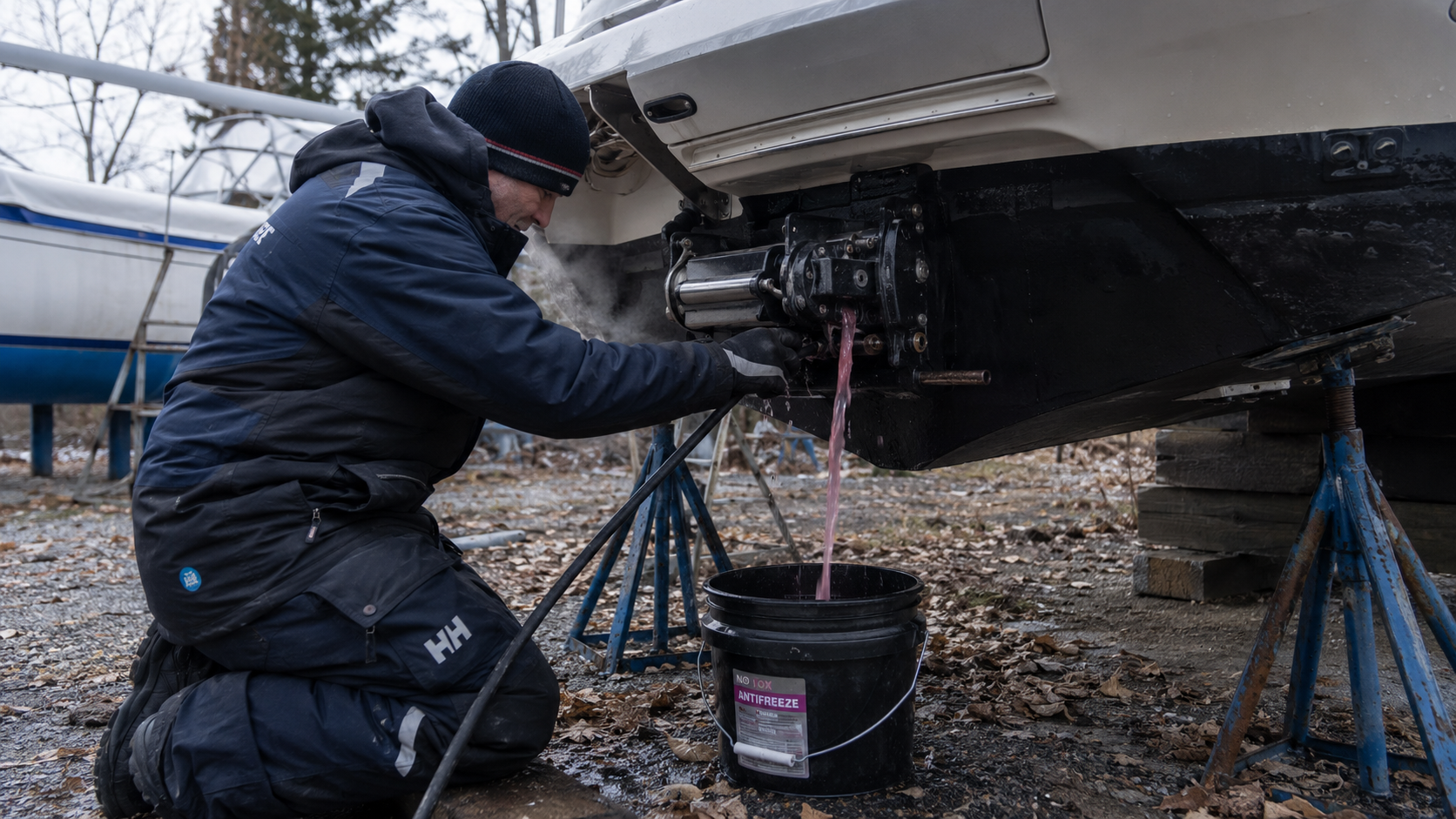
After draining, run non-toxic propylene glycol antifreeze rated to at least minus 50 degrees Fahrenheit through the cooling circuit. Do not use automotive antifreeze - it is toxic and is not rated for contact with potable water systems. If the vessel has AC, refrigeration, or a generator, each of these systems requires its own winterization protocol. If you are hiring a yard, confirm in writing that all three are included in the scope of work.
Jackstand Placement: How to Support Your Boat Safely Over Winter
Incorrectly placed jackstands are a consistent cause of winter storage damage and, in the worst cases, vessel loss. Stands placed too close to the hull or set in inadequate substrate can shift or fail under the combined weight of a vessel and accumulated snow and ice.
Use at minimum three stands per side for boats over 26 feet. Position them as far outboard as the hull geometry allows for maximum stability in high winds. Each stand base must bear on firm material - asphalt softens in winter rain, mud shifts, and sand compresses. Place sturdy plywood sheets under each base and connect stands with safety chains as a secondary retention measure.
Choosing and Installing the Right Winter Cover - and Why Ventilation Is Non-Negotiable
A properly installed winter cover protects gelcoat, sheds snow and ice load, and keeps standing water off decks. A poorly installed one does none of these effectively - and adds risk of its own.
A cover without an adequate support frame transfers snow load directly onto stanchions, which are not designed for vertical compression. Build a proper ridge frame before covering, or have a professional yard install shrinkwrap with a structural frame. For shrinkwrap, insist on proper ventilation ports at the time of installation. An unvented enclosure traps humidity, creating conditions for mold growth that can cause extensive damage to upholstery, electronics, and interior surfaces.
Never apply shrinkwrap without full knowledge of the process. A heat gun and flammable material are a serious fire risk.
Why Leaving a Heater Running on an Unattended Boat Is a Documented Fire Risk
Leaving a portable heater running on an unattended boat is both a fire risk and a false sense of security. The core problem: power outages during winter storms stop the heater - and a properly winterized engine does not need supplemental heat. If the engine has been drained and treated with antifreeze, it is protected. If it has not, a single power outage eliminates the only protection you have.
Winterize the engine and systems correctly. If supplemental heat is genuinely required for a specific component, use thermostatically controlled heat tape rated for marine use - not a portable space heater left running unattended.
How to Clear All Drain Points Before Winter to Prevent Freeze Damage
Boats have drain points in more locations than most owners track: cockpit floors, stanchion bases, mast steps, livewells, bait wells, and various deck hardware. Any that becomes blocked and allows water to pool creates freeze-damage risk. Clear them all before the first hard freeze.
Check seacocks as well - many include small drain plugs that allow trapped water to escape from the fitting body. Confirm each one is functional before closing the boat for winter.
How to Drain Your Boat's Rudder Before Winter Storage
A rudder that drips water after haulout contains water that will freeze, expand, and potentially delaminate the fiberglass structure. The fix is straightforward: drill a small drain hole at the bottom of the leading edge before winter, allow the rudder to drain fully, and patch the hole in spring with appropriate marine epoxy before relaunch. Skipping this step risks a repair that far exceeds the cost of the drill bit.
Managing Cockpit Ice for Boats Wintered in the Water
Boats left in slips over winter face a specific freeze-thaw risk. Ice forming at cockpit scupper outlets can plug drainage entirely. When the ice melts - and rain or meltwater follows - the cockpit fills. When temperatures drop again, that water refreezes. Enough accumulation can force the stern dangerously low and create a flooding condition.
Visit in-water boats after every significant weather event. Clear cockpit scuppers after each storm. This is not optional maintenance for commercial vessels that must be operational in spring.
Why You Should Never Let an Unqualified Person Winterize Your Vessel
The most consistently disastrous winterization outcome is one that starts with "I let my buddy do it." Winterization is systematic, sequential work - every step exists for a reason, and a single omission is a potential claim. The water drained from the main engine block is not the same water trapped in the manifolds. The antifreeze run through the freshwater system is not the same antifreeze required in the AC circuit.
If you are not confident completing a full winterization yourself, hire an experienced professional yard and get a written scope of work before authorizing anything. That scope should list every system: main engine, AC, refrigeration, generator, freshwater, and any aboard systems specific to your vessel. If it is not explicitly listed, do not assume it will be done.
For fleet operators and commercial vessel managers, logging each winterization task as completed - by system, date, and technician - is not just good practice. It is the documentation that supports or defeats a claim if a freeze event occurs despite precautions.
Winterization Checklist
Drain engine cooling circuit, manifolds, and heat exchanger completely
Run propylene glycol antifreeze (rated to -50°F) through engine cooling circuit
Drain and treat freshwater system, water heater, and sea strainers with non-toxic antifreeze
Winterize AC system, refrigeration, and generator - confirm in writing if hiring a yard
Place jackstands correctly with firm substrate, plywood bases, and safety chains
Install winter cover with proper support frame and ventilation
Clear all cockpit drains, stanchion base drains, deck hardware, and seacocks
Drill and drain the rudder if it shows any dripping after haulout
Clear cockpit scuppers after every winter storm (in-water boats)
Document every completed step by system, date, and technician
Frequently asked questions
What is the most important step in winterizing a boat?
Removing all water from every water-holding component - the engine cooling circuit, manifolds, heat exchanger, freshwater system, sea strainers, and cockpit drains - is the single most critical winterization step. A single hard freeze in any of these components can cause cracking or rupture. Partial winterization is nearly as risky as none.
How cold does it have to be to damage a boat engine?
Engine damage can occur at any temperature below 32 degrees Fahrenheit if water remains in the cooling passages. A single overnight hard freeze is sufficient to crack a manifold or engine block that was not properly drained and treated with antifreeze.
What antifreeze should I use to winterize a boat?
Use non-toxic propylene glycol antifreeze rated to at least minus 50 degrees Fahrenheit. Do not use automotive antifreeze - it is toxic and not suitable for freshwater systems, sea strainers, or any engine circuit that may contact potable water.
What happens if you don't winterize a boat?
A boat that is not properly winterized is at serious risk of freeze damage to the engine, manifolds, heat exchangers, freshwater systems, and hull fittings. Repair costs from a single freeze event can easily exceed $10,000 to $15,000, and some damage - such as a cracked engine block - may render the engine unrepairable.
When should I winterize my boat?
Complete winterization before nighttime temperatures consistently fall below 32 degrees Fahrenheit. In most northern US climates, this means completing all winterization work by October or early November. In borderline climates, err early - a single freeze event before winterization is complete can cause the same damage as no winterization at all.
Can I winterize my own boat?
Most boat owners can complete their own winterization with the right materials and a comprehensive checklist. The critical requirement is completing every step - partial winterization creates nearly as much risk as none. If hiring a professional yard, get the full scope of work in writing and confirm it includes every system aboard.
Ready to modernize your vessel operations?
See how Vessel Vanguard helps marine operators stay compliant, reduce downtime, and run more efficiently.
Book a Demo